Posts

'Guilt and fury: how Covid brought mothers to breaking point’, Natasha Walter, Guardian 28 Feb 2021

Image
  This needs sharing far and wide — Natasha Walter’s brilliant article on the feminism of care .  * Here’s how I see things, relative to that thing I call ‘Motherload’. Care is the highest value humanity has. My personal metaphor or shorthand for it has long been ‘Motherload’ (as any avid reader of this blog will exhaustedly be aware). The visible and invisibilised labour of care. Others have termed it the ‘mental load’, the ‘emotional load’. It doesn’t really matter what label we give it, we are always brought back to this idea of a burden, and the question of what to do with it. The greatest vulnerability that carers face is not that others exploit what they offer, it is that those who care cannot not care. Whether it is a role more or less willingly or resentfully adopted, or an identity thoroughly embraced and celebrated, those who care cannot put that load down . They do not allow themselves to, and they do not want to. They want to carry their Motherloads.  And th...

Covid Lockdown: the Motherload Vaccine

Image
  Injections hurt. But not as much as the disease they teach the body about. I do not want to say that I am cured of my Motherload. Like ham, I think that would imply something… dried out . Preserved, but at a cost. Sliced like salami and sold in packets. Perhaps instead the right metaphor would be ‘inoculated against’? After all, what would I be cured of? To be cured of Motherload – that tentacular, polyvalent term which signifies every woman’s complex relationship with her reproductive function, throughout her lifetime, and always in a fraught social and cultural context – would mean… to be withered, a crone, abandoned, pointless. Redundant. I’m not quite ready for that, being still alive.  No, ‘Motherload’ in that sense, I don’t think can be cured. Like DNA, Motherload partakes of the very stuff of life, it is a principle of creativity. A handy mnemonic to understand that creation always also implies an act of destruction, at once a fusion which elides difference, and a fis...

Crow Pose: my bête noire

Image
I have been trying to get into Crow Pose without success for at least a decade, probably longer.  I’ve also been trying to recover from being bullied out of my academic career, by a vicious female head of department, for the simple misdemeanour of having a baby, even longer. Since 2004, as it happens.  Yes, I’m ashamed, both by the ousting, and by how long it takes to recover from bullying. Move on!  I hear you cry. Let go of the past!   She can’t hurt you now! What are you waiting for? Would that it ’twere so simple, dear reader.  ‘Recovering from being bullied’ doesn’t mean lying in a darkened room for fourteen years, fanning yourself. No, there’s been a living to earn, children to raise, a husband to support, sometimes financially, and a few other choice life events I won’t bore you with here. So ‘getting on with it’ hasn’t been my problem. Recovery , on the other hand, healing… well, that’s a very different murder of crows.  All through that time, I hav...

Working Life for Working Mothers, chapter 2020: the Covid Years

Image
Lady Writer on the Verge What has working life been like for mothers under lockdown, I hear you cry? Far be it from me to hold back. Here is my view from the edge. My experience of 'working motherhood' is no longer linked to corporate life. As avid readers of this blog will know only too well, I was an academic, a lecturer at Cambridge in the early noughties, but was bullied into resigning after having my first baby, by my female head of department. Blah blah blah, old news. Ever since, I have focused on, experimented with and written about effective practices for working mothers — been frustrated by the ineffective ones, and taken matters into my own hands. Matters, maters, martyrs, eventually ending up on the yoga mat. I have worked from home as a writer and education consultant since 2012, when I told my husband, “I’m not going back into an office again”.  After my beloved mother died, I built an office in the garden, in the Autumn of 2018. It is my Room of Mum’s Own, my She...

Literary Movement – a review of Beneath My Feet: Writers on Walking

Image
Literary Movement Beneath My Feet: Writers on Walking ed. Duncan Minshull Notting Hill Editions,  2018,  £9.99 Beneath My Feet is an anthology of writers meditating on walking, intended to be ‘tucked into a rucksack’. Conjuring visions of hiking with Kendal mint cake in one hand and Wordsworth in the other, it is a wonderful assemblage.  I originally wrote this review for another publication, but managed to miss my deadline by a few days, after which it seemed to go walkabout. So I’ve decided to post it here. After all, this particular gem may come into its own again, if Covid comes back to bite us in the Autumn.  I blame Rebecca Solnit for missing my deadline. ‘I sat down one spring day to write about walking and stood up again, because a desk is no place to think on the large scale,’ she begins.  As soon as I read this sentence, I went for a walk.  It may not have been on a large scale, but early morning constitutionals, golden hour passeggiata, foraging ...

Care for the carers or they won't care for you

Image
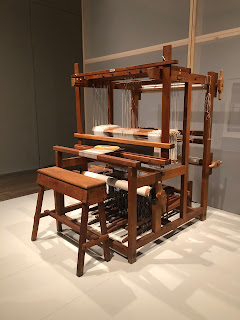
Anni Albers's loom This, published in the New York Times, 8 May 2020. Where have you been all my life, Kim Brooks? I love you. Forget Pancakes. Pay Mothers . Yes. Yes. Lysistrata. Cinderella. Wages for Housework, Italy, 1972. Studs Terkel. Work done in the home is work . Cooking, cleaning, making, mending. Labour. Labour should be remunerated. Fairly. It takes skill to clean and care. It can be itemised, shown as a workload document. This work is not invisible. It exists and can be quantified. It is invisibilised, feminised, certainly. But it is not women's work for all that. I needed a doctorate to raise children. I needed a doctorate to ward off the shit that is flung at women once they become mothers (or indeed if they don't become mothers). Shit is just flung at women, and they are expected to suck it up, clean it off, say nothing, be pretty, and be flung on the heap when they're done. Fuck that. Pay carers, or you'll end up paying the ...

Women are writing less during Lockdown than men. Why would that be, then?

Image
The stereotyped image of the 'working mother' Female academics are writing less during Lockdown than men. Why would that be, then? To enlighten myself, I read an article today – here's the headline: Women academics seem to be submitting fewer papers during coronavirus. ‘Never seen anything like it,’ says one editor.  Men are submitting up to 50 percent more than they usually would I wonder if readers of this blog will be able to guess my response? Yes? No? I'm unable to restrain myself anyway, so here goes…To sum up, and at the risk of sounding like the Daily Mash , this is more fabulous Motherload nonsense from the No Shit Sherlock School of Research, University of Life. Go on then, I know you know I want to. Let me spell out why.  Particular restatements of the problem, as opposed to doing anything, anything at all, about the solution (um... men need to do more housework and let go of some of their entrenched power; women need to stop trying to do ...

The Pandemic and the Female Academic or Motherload in a time of Covid

Image
Two people recently sent me a piece called ' The Pandemic and the Female Academic ', so I felt it incumbent upon me to clamber back onto my Motherload soapbox, lean from the top floor window of my coronavirus lockdown retreat, and scream into the indifferent winds. Very yogic. This is a paraphrased version of what my poor unwitting friends received in response: Thank you! Mmmmm… thesis: "it's going to be even harder for women with children to get their work done if they are on lockdown at home."    I don't want to appear rude, but isn't this of the No Shit Sherlock school of writing? This is normal Motherload, merely topped off with the whipped cream of pandemic.   And BTW I have never heard the term 'maternal wall' before, in all the years I've spent banging my head against it, writing about the nonsense that is combining children and a career as a woman. Speak soon, love, Ingrid. Although when I come to think of it, whenever I have...

Eaten up by privilege

In the brilliant, provocative, honest  Nickel and Dimed , Barbara Ehrenreich takes a deep dive into the world of low-paid work in America. The story she has to tell is in some ways predictable. She can't make ends meet on the kind of money the lowest-paid make. No shit, Sherlock. What saves her account from turning those low-paid people into victims, and turns them instead into the  victimised  — people thrown under the wheels of a systemic problem: Capitalism — is that she never tries to hide the fact that she is privileged, well-educated and cushioned. Her honesty in admitting and claiming this (she makes no bones about the fact that she would never willingly choose to take a low-paid job) means that her work exists in a realistic framework. She is in no sense romanticising the 'poor who are always with us'. And she is not justifying herself.  No one can accuse you of what you claim as your own. How I love that her name means 'rich in honour'...

On Jonah Lehrer and living with lies

Image
Jonah Lehrer Jonah Lehrer's 2012 fall from grace, following the discovery of errors and 'self-plagiarism ' in his published work, is a well-known story in academic and journalistic circles. It seems to have been, not his editorial mistakes, which are so easy to make, as much as his subsequent lies and deception about them, which really turned people off, and caused his spectacular career shutdown.  In July 2016, Lehrer told the story of 'what happened next', for The Moth in Los Angeles, where he lives with his wife and children. Before you read any further, please listen to what he has to say: he calls the story ' Attachment '.  I had been made aware of Lehrer's book Proust was a Neuroscientist back in 2007, by friends who knew I'd written on Proust, and who sent me copies of his work. Professional jealousy compelled me to smile publicly but privately find fault with it – he seemed only to have read the opening pages of A la recherche ...